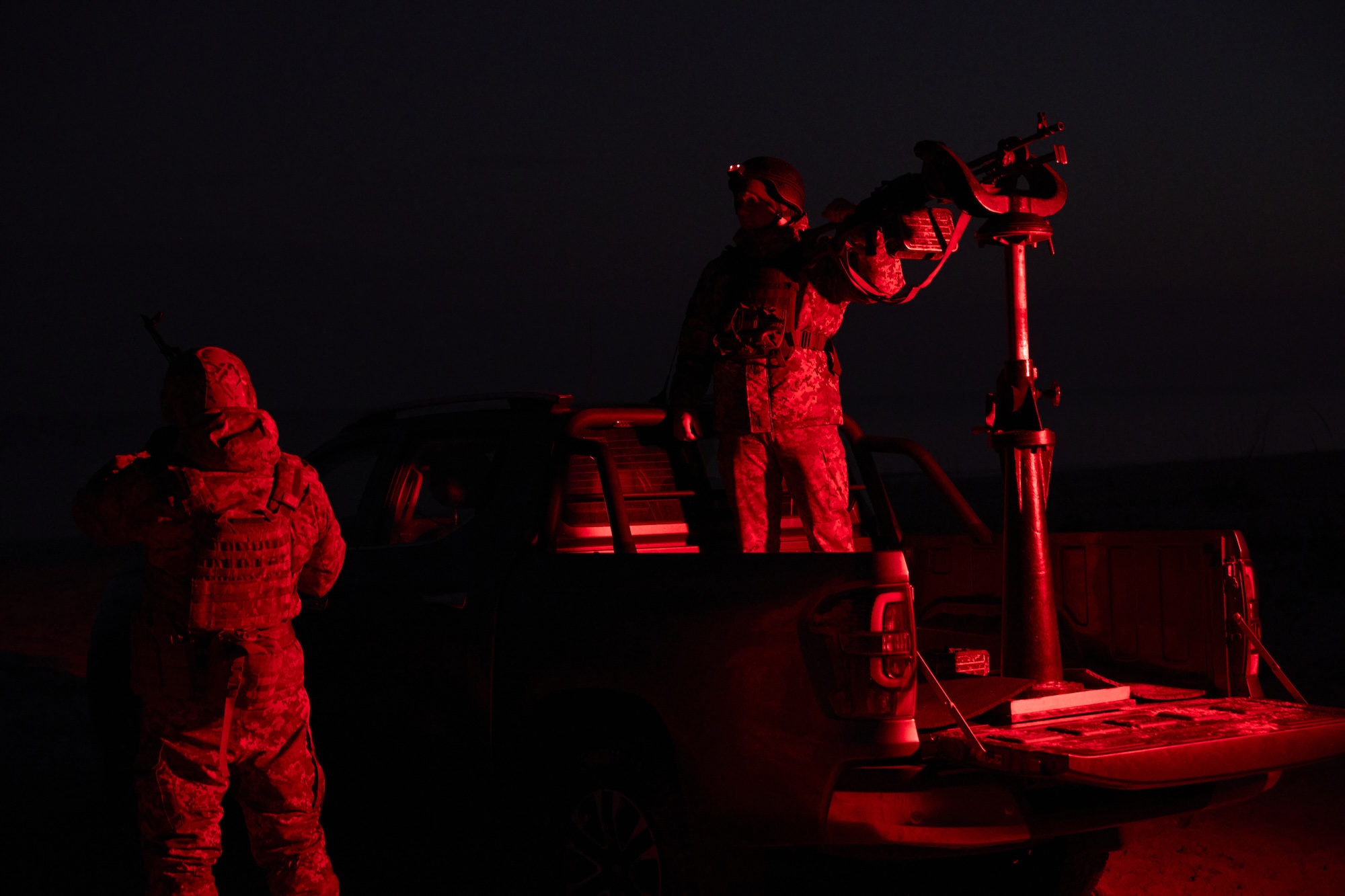
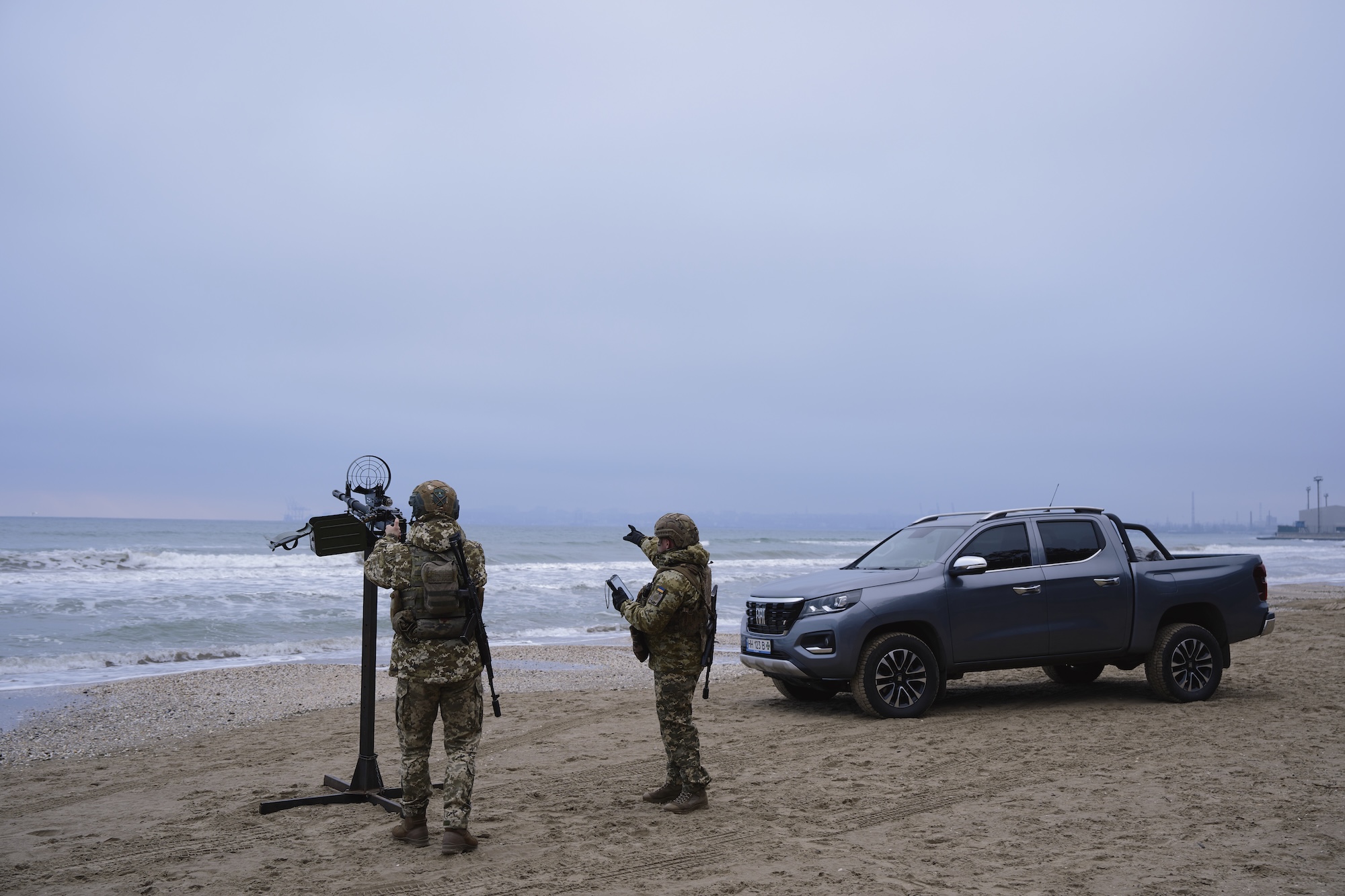
Ukraine’s mobile air defense units operate within the Armed Forces, the National Guard, and the State Border Guard Service. They were established in response to the massive wave of Russian drone attacks. Their primary mission is to detect and shoot down Russian attack drones—most commonly Shahed-131 and Shahed-136 UAVs. Depending on the unit and the operational situation, they are equipped with heavy machine guns (such as the M2 Browning or DShK), anti-aircraft cannons, or man-portable air-defense systems (MANPADS) like the Stinger or Mistral. These weapons are typically mounted on vehicles, often pickup trucks. Many units also use powerful searchlights to illuminate targets during nighttime operations.
Nadin Heinich: Do you work as a team?
Nazar: Most of the time, there are three of us: a gunner, an assistant, and a coordinator who stays in contact with the command center. We work in shifts, with teams rotating on and off duty.
Nadin Heinich: These mobile air defense units are part of the State Border Guard Service. What does that mean in Odesa?
Nazar: The Border Guard Service is under the Ministry of Internal Affairs and has several responsibilities, not just mobile air defense. We secure the border and the surrounding border areas. In the Odesa region, that includes coastal sections, port facilities, and access routes. We also operate on the water, supporting security and defense operations in the coastal zone, including—depending on the situation—countering unmanned systems. And during the war, the Border Guard also takes part in combat operations whenever fighting breaks out in border regions. Our units are deployed on the front line in areas such as Donetsk and Sumy.
Nadin Heinich: Last week, on December 13, Odesa experienced one of the heaviest Russian attacks since the start of the full-scale invasion. As we speak, there is another air raid alert. What does your daily routine look like? Are you able to plan ahead?
Nazar: Only to a limited extent. Since the full-scale invasion, we have known what the enemy is capable of. Even so, the massive attack on December 13—especially against the energy infrastructure—was severe. Normally, one part of the unit rests while the other is on duty. During major waves of attacks, that is hardly possible. Then everyone has to remain on constant alert.
Nadin Heinich: Do you mainly work at night?
Nazar: In the current situation, it can happen that we spend an entire shift—up to 24 hours straight—continuously on operations.
Nadin Heinich: Drone technology is evolving extremely fast. How has the war—and with it your work—changed since 2022?
Nazar: Our workload has increased dramatically, as has the scope of our responsibilities. I was already serving with the Border Guard before the war. Back then, our main task was border security. We did not face large-scale drone attacks. Today, we also have to monitor the airspace. Drones are becoming more capable, with greater range, and the tactics keep changing. Our countermeasures are evolving as well. I cannot go into too much detail, but one example is interceptor drones: fast FPV drones deployed to intercept and destroy attack drones such as the Shahed. There is another threat as well: enemy reconnaissance teams or small groups can operate far behind the front lines, sometimes disguised in civilian clothing.
Nadin Heinich: Are you personally often a target?
Nazar: In war, all military personnel are potential targets. Because we shoot down drones—even those that are merely passing through rather than attacking Odesa directly—we are a relevant target for the Russians. At the same time, their current priority is often the destruction of energy infrastructure. Overall, our work has become significantly more dangerous since the full-scale invasion.
Nadin Heinich: How old are you?
Nazar: Twenty-four.
Text: Nadin Heinich
Photos: Heinrich Völkel
Odesa is younger than its myth suggests—and at the same time older than Catherine the Great. The name “Odesa” first appeared in a document dated 21 January 1795. In 1792, following the Treaty of Jassy, the territory became part of the Russian Empire. Two years later, Catherine II ordered the construction of a military harbour and commercial port at the settlement then known as Khadzhibei. Under the direction of the Spanish-born officer José de Ribas, work on the harbour facilities and cathedral began on 2 September 1794—a date that Odesa continues to celebrate as the city’s official founding day.
Yet the new city was not built on empty land. Khadzhibei had existed since the early fifteenth century as a settlement founded by the Crimean Khan Hacı Bey, complete with a fortress, mosque, Muslim cemetery, taverns and an already significant grain port. Over the centuries, the settlement passed from the Crimean Khanate to the Grand Duchy of Lithuania, later to the Ottoman Empire, and only afterwards came under Russian rule. The imperial narrative of Odesa’s “founding” by Catherine the Great largely overlooks this earlier history.
During the nineteenth century, Odesa developed into one of the Russian Empire’s most dynamic ports and trading centres. Its rise was driven by the success of the harbour, liberal administrative policies and its status as a free port between 1819 and 1859. Governors such as the French-born Duke of Richelieu, who led the city from 1803 to 1814, and later Count Mikhail Vorontsov, Governor-General of New Russia and Bessarabia, laid out its strict orthogonal street grid, recruited Western engineers and physicians, and established theatres, a public library, a lycée and learned societies. Trade in grain and other commodities attracted Germans, Greeks, Jews, Italians, Ukrainians, Russians, Armenians and many others. Cosmopolitan Odesa became the fourth-largest city in the Russian Empire, after St Petersburg, Moscow and Warsaw. This period is still widely regarded as the city’s “Golden Age”.
It is precisely this legacy that makes today’s debates so contentious. Odesa’s Golden Age was inseparable from the structures of the Russian Empire. Under the 2023 Ukrainian law On the Condemnation and Prohibition of the Propaganda of Russian Imperial Policy in Ukraine and the Decolonisation of Toponymy, municipalities are required to remove from public space names, symbols and monuments associated with the Russian Empire, the Soviet Union or the present-day Russian Federation.
