What impact does public space have on society?
Carlo Ratti, a pioneer in digital urbanism and architecture, opened his presentation with this question and surprised the audience with his answer: “We will not find solutions if we communicate exclusively through digital means.”
Drawing on his data-driven research projects, Ratti illustrated the growing uncertainty and transformation within society. He analyzed email communication patterns at American universities before and after the Covid-19 pandemic, when physical encounters became impossible. A comparison between video recordings of public life in New York City during the 1980s and observations from today led to similar conclusions: people engage far less frequently in direct, face-to-face interaction than they once did.
His argument was clear: we need social connections—so-called “weak ties,” a concept developed by Robin Dunbar—to break out of familiar patterns of thinking and become open to different perspectives and opinions.
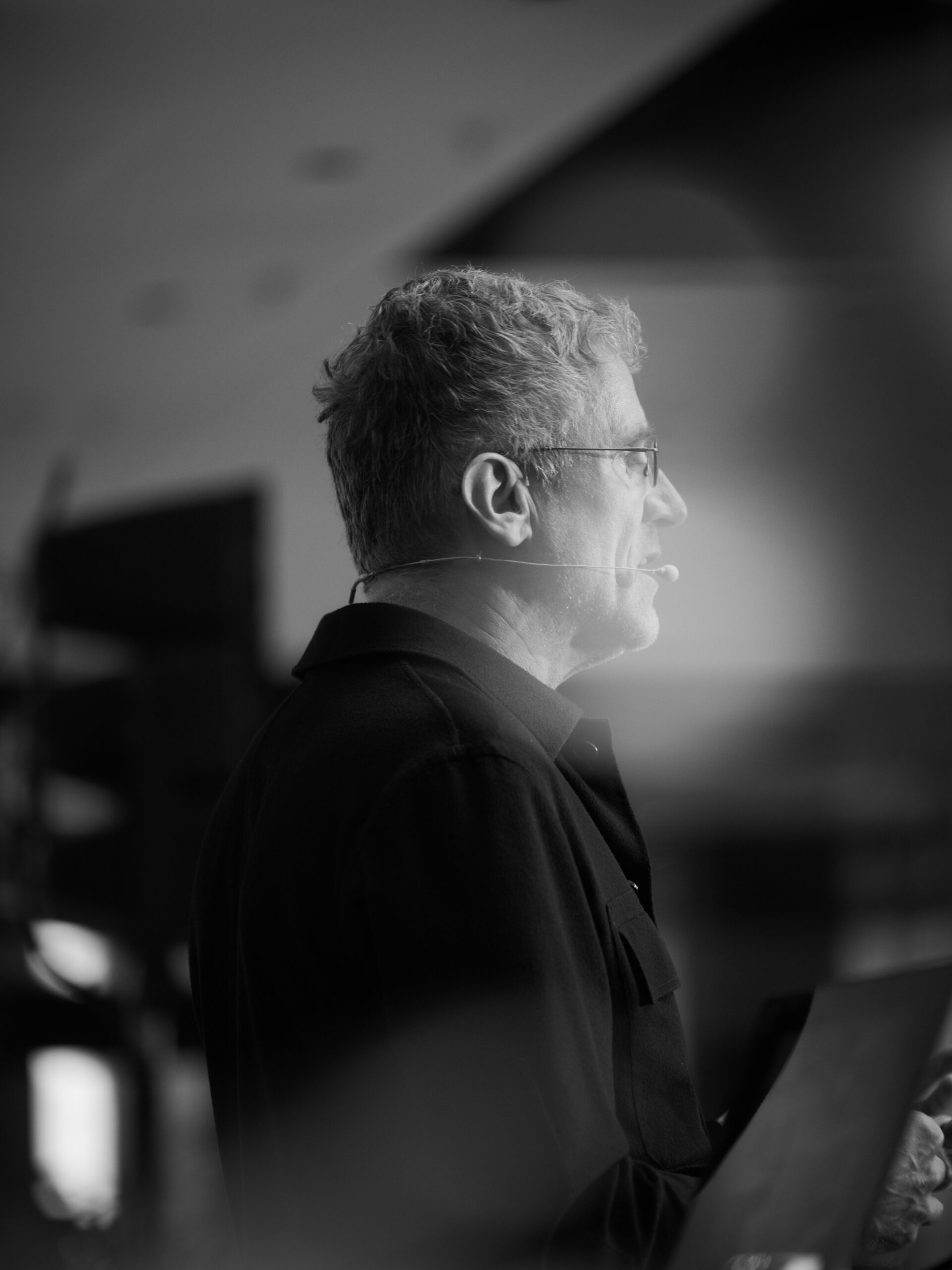
Drawing on his own projects, Ratti demonstrated how architecture can create the conditions for such encounters—places where strangers meet, interact, and exchange ideas. He sees performative architecture as a catalyst for these connections, whether through the visitor-controlled water curtain of the Zaragoza Expo Pavilion or a public park suspended halfway up a skyscraper in Singapore.
For the curator of the 2025 Venice Architecture Biennale, Aldo Rossi’s Teatro del Mondo (1980) remains a powerful model for the shared experience of culture, nature, and water. Inspired by Rossi’s floating theater, Ratti collaborated with Howeler + Yoon last summer on a floating public platform. Following the Biennale, the structure was towed across the Atlantic to Belém, Brazil, where it served as a symbol at the UN Climate Change Conference, drawing attention to the urgent issue of rising sea levels.
About
Carlo Ratti has a deep passion for cities and the built environment. A practicing architect, he teaches at the Massachusetts Institute of Technology, where he directs the Senseable City Lab. He graduated in engineering from the Politecnico di Torino and the École Nationale des Ponts et Chaussées in Paris, and later earned his MPhil and PhD in architecture at the University of Cambridge, UK. Carlo holds several patents and has co-authored over 250 publications. His work has been exhibited worldwide at venues such as the Venice Biennale, the Design Museum in Barcelona, the Science Museum in London, GAFTA in San Francisco, and the Museum of Modern Art in New York.
In 2025, he curated the 19th International Architecture Exhibition of the Venice Biennale, titled “Intelligens. Natural. Artificial. Collective”. Working at the intersection of research, design, and entrepreneurship, he aims to provoke public debate about urban life and to explore new ways in which technology, architecture, and society can interact.
